Indigenous People of the Arctic - Mansi
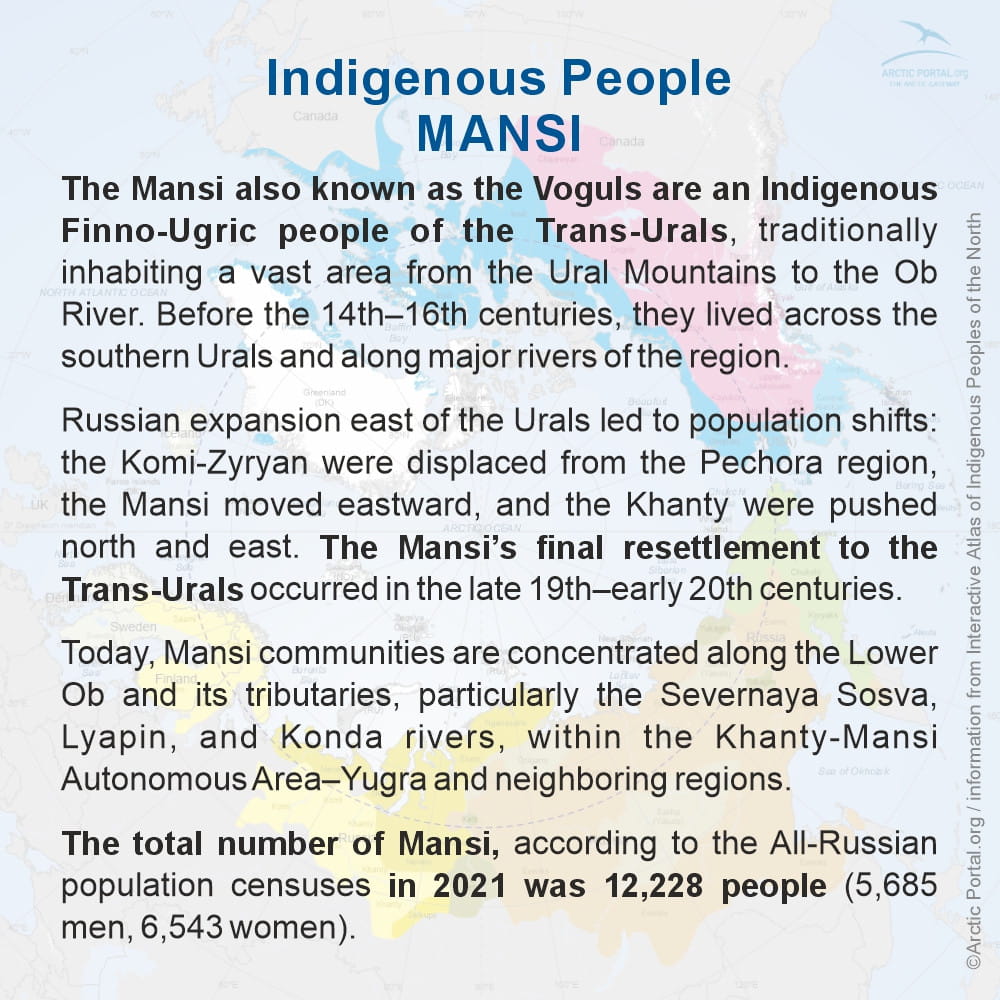
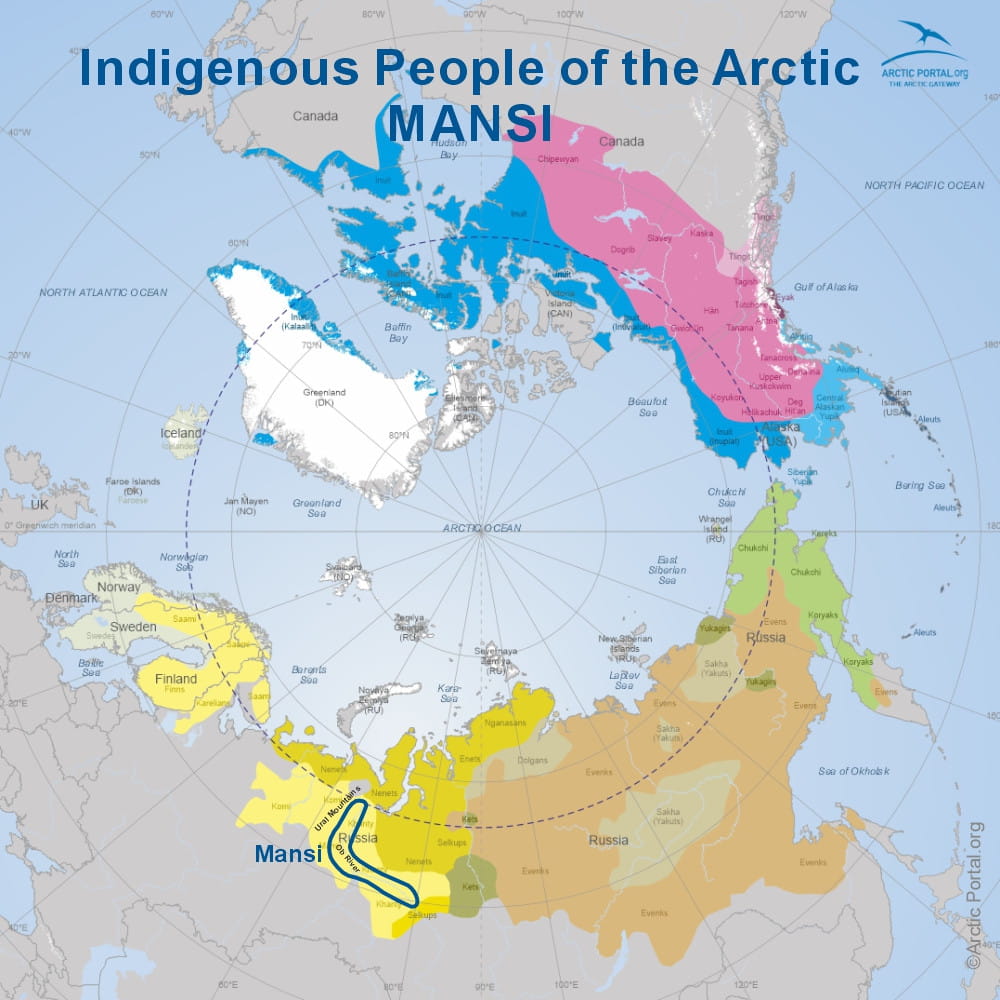
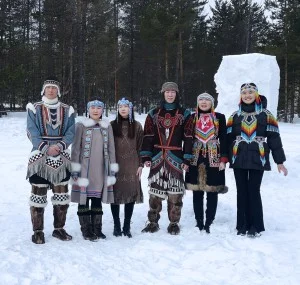
The Mansi also known as the Voguls are an Indigenous Finno-Ugric people of the Trans-Urals, traditionally inhabiting a vast area from the Ural Mountains to the Ob River. Before the 14th-16th centuries, they lived across the southern Urals and along major rivers of the region.
Russian expansion east of the Urals led to population shifts: the Komi-Zyryan were displaced from the Pechora region, the Mansi moved eastward, and the Khanty were pushed north and east. The Mansi’s final resettlement to the Trans-Urals occurred in the late 19th–early 20th centuries.
Today, Mansi communities are concentrated along the Lower Ob and its tributaries, particularly the Severnaya Sosva, Lyapin, and Konda rivers, within the Khanty-Mansi Autonomous Area–Yugra and neighboring regions.
The total number of Mansi, according to the All-Russian population censuses in 2021 was 12,228 people (5,685 men, 6,543 women).
People & Language
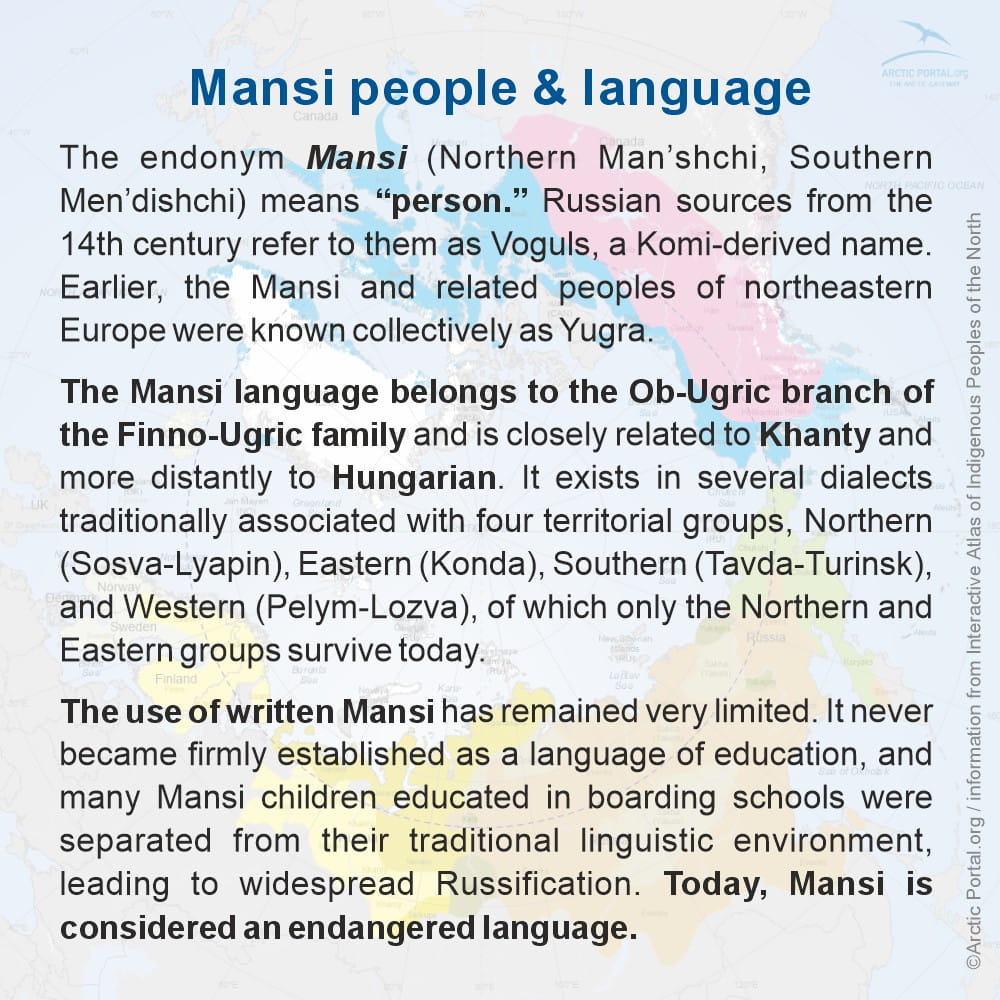
The endonym Mansi (Northern Man’shchi, Southern Men’dishchi) means “person.” Russian sources from the 14th century refer to them as Voguls, a Komi-derived name. Earlier, the Mansi and related peoples of northeastern Europe were known collectively as Yugra.
The Mansi language belongs to the Ob-Ugric branch of the Finno-Ugric family and is closely related to Khanty and more distantly to Hungarian. It exists in several dialects traditionally associated with four territorial groups, Northern (Sosva-Lyapin), Eastern (Konda), Southern (Tavda-Turinsk), and Western (Pelym-Lozva), of which only the Northern and Eastern groups survive today.
The use of written Mansi has remained very limited. It never became firmly established as a language of education, and many Mansi children educated in boarding schools were separated from their traditional linguistic environment, leading to widespread Russification. Today, Mansi is considered an endangered language.
People & Culture
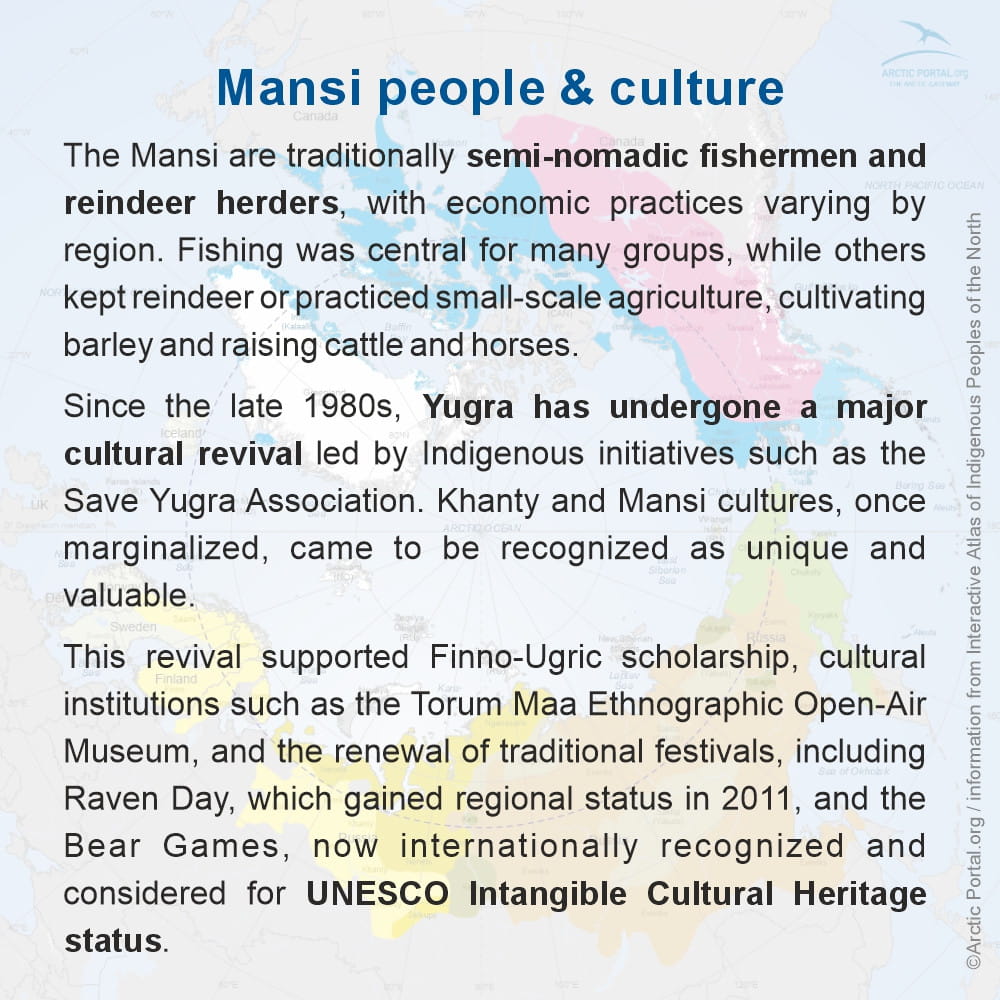
The Mansi are traditionally semi-nomadic fishermen and reindeer herders, with economic practices varying by region. Fishing was central for many groups, while others kept reindeer or practiced small-scale agriculture, cultivating barley and raising cattle and horses.
Since the late 1980s, Yugra has undergone a major cultural revival led by Indigenous initiatives such as the Save Yugra Association. Khanty and Mansi cultures, once marginalized, came to be recognized as unique and valuable.
This revival supported Finno-Ugric scholarship, cultural institutions such as the Torum Maa Ethnographic Open-Air Museum, and the renewal of traditional festivals, including Raven Day, which gained regional status in 2011, and the Bear Games, now internationally recognized and considered for UNESCO Intangible Cultural Heritage status.
Spiritual Culture of the Evens
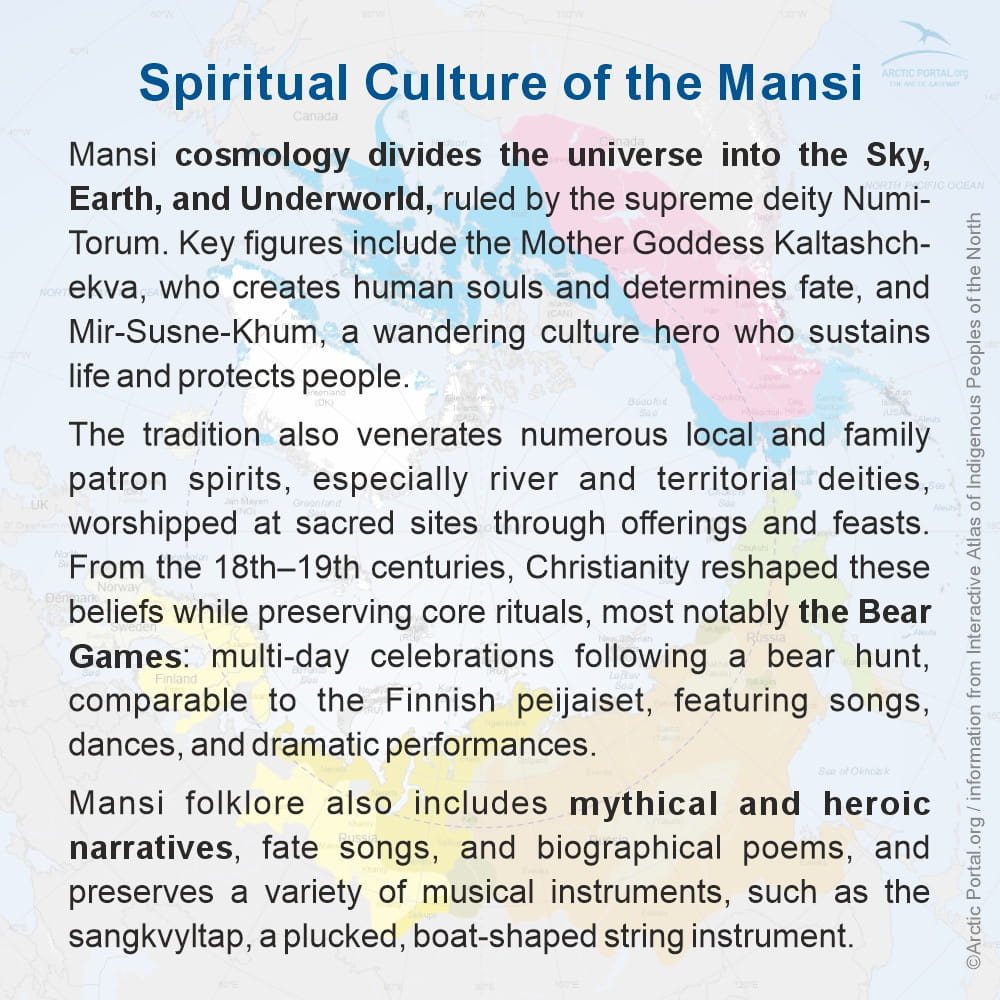
Mansi cosmology divides the universe into the Sky, Earth, and Underworld, ruled by the supreme deity Numi-Torum. Key figures include the Mother Goddess Kaltashch-ekva, who creates human souls and determines fate, and Mir-Susne-Khum, a wandering culture hero who sustains life and protects people.
The tradition also venerates numerous local and family patron spirits, especially river and territorial deities, worshipped at sacred sites through offerings and feasts. From the 18th–19th centuries, Christianity reshaped these beliefs while preserving core rituals, most notably the Bear Games: multi-day celebrations following a bear hunt, comparable to the Finnish peijaiset, featuring songs, dances, and dramatic performances.
Mansi folklore also includes mythical and heroic narratives, fate songs, and biographical poems, and preserves a variety of musical instruments, such as the sangkvyltap, a plucked, boat-shaped string instrument.
Source: Interactive atlas of indigenous peoples of the North, Siberia and the Far East
Visit our Map Gallery Arctic Portal specializes in creating customized graphical maps that cover a range of significant Arctic topics with global recognition. We are continuously working on new maps and adding them to our Gallery.