
News
WWF study: Shipping expansion in Nunavut could make waters too loud for migrating whales
According to a recent model study by WWF Canada, Foxe Basin and Hudson Strait in Nunavut could become so loud in the next 7 years due to shipping that whales might change their migration patterns.
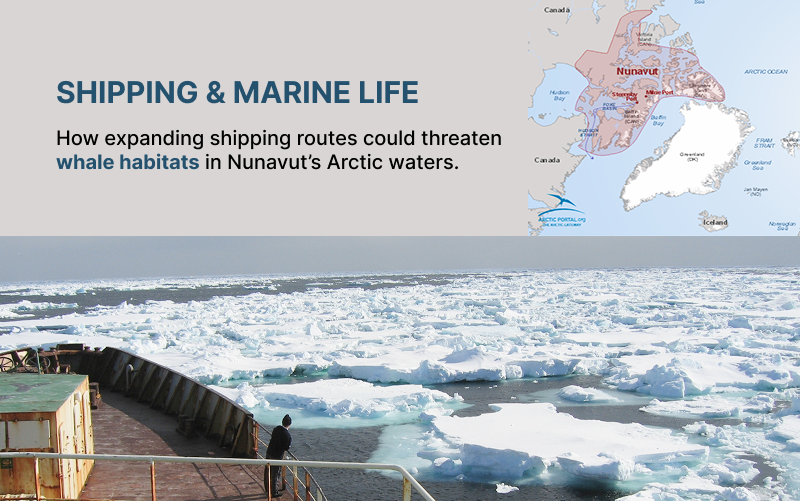
A recent study by WWF Canada, titled “The Future of Underwater Noise in Foxe Basin & Hudson Strait: What a rapid increase in shipping means for acoustic habitat” urges for more research into the impacts of the planned shipping expansion in Nunavut. Ship activity in Nunavut is on track to increase significantly by the end of the decade. The study says that the increased amount of sound could negatively impact whales, for which this is a key migration corridor.
In Foxe Basin and Hudson Strait, the primary driver of this growth is expected to be the Steensby Component of Baffinland’s Mary River Mine Project. To support this expansion, Baffinland plans to shift its shipping operations from Milne Inlet to Steensby Inlet, meaning ships servicing the mine will transit Hudson Strait and Foxe Basin. The project includes construction of a deepwater port at Steensby Inlet and a railway across southern Baffin Island, a more than fourfold increase in annual ore shipments from 4.2 million tonnes (Mt) to 18 Mt, year-round shipping with icebreaker support, and an increase in ore carrier transits from 84 to 242 per year.
The map below illustrates the location of the proposed Steensby Port and the surrounding marine areas, including Foxe Basin and Hudson Strait, which would be affected by the planned expansion of shipping activities.
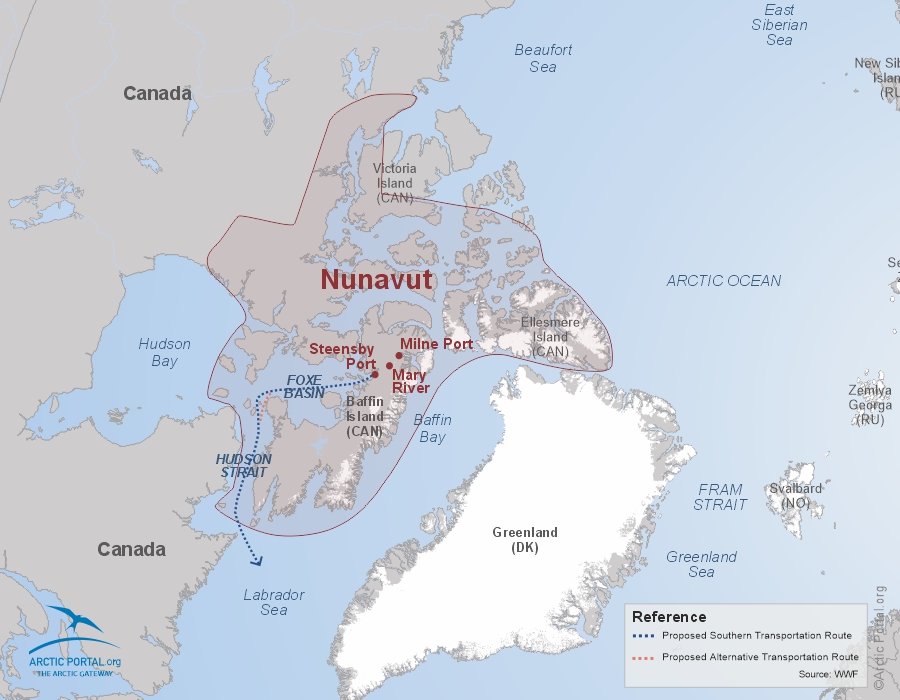
Map showing Nunavut, the proposed Steensby Port development on Baffin Island, and the surrounding marine areas of Foxe Basin and Hudson Strait, where increased shipping activity could affect important whale migration routes. Credit: Arctic portal
This new shipping route will intersect with one of the most ecologically important marine regions in Canada. Hudson Strait connects Foxe Basin to the Labrador Sea, forming a marine “superhighway” for narwhal, bowhead, and beluga whales. Foxe Basin also supports the largest walrus population in Canada. These ecological values are formally recognized.
Model predicts that by 2030 the waters could be 16 times louder
The WWF Study models noise produced by shipping and compares two points in time – from 2019 and a projected 2030 status. The 2030 model is based on literature reviews and interviews with experts regarding the issue. By 2030, vessel activity is projected to increase across the region, though unevenly. Ore carriers servicing the Mary River Mine are anticipated to be the primary driver of increased traffic.
Due to this, underwater noise is projected to increase and become more persistent by 2030. In Hudson Strait, ship noise is expected to exceed natural sounds nearly all the time. In Foxe Basin, ship noise is expected to exceed natural sound approximately half of the time, representing a shift from occasional disturbance to frequent and sustained underwater noise. Along Baffinland’s southern shipping route, median sound pressure levels are projected to increase by 11.9 dB. This is equivalent to an approximate 16-fold increase in sound intensity. In the busy parts of the season, it could be even more than that.
Whale sensitivity to sound – why does it matter? A story from Eclipse Sound

Whales communicate using sound and thus are more sensitive to it. An article published in Nature magazine by researchers from the Scripps Institution of Oceanography at the University of California San Diego found that Narwhals appear to either move away or stop vocalizing as ships approach, with acoustic detections resuming at similar distances after ships have passed. The scientists also suggest that previous research may have underestimated the whales behavioral sensitivity to noise in the researched area in Eclipse Sound.
According to WWF, Underwater noise can force species to leave familiar habitats. In Eclipse Sound, where Mary River Mine shipments began in 2015, Inuit hunters have reported fewer narwhal, seals, seabirds and Arctic char in waters that have sustained communities for generations. The Steensby expansion would increase these impacts and bring them into new habitats, affecting more communities that rely on marine wildlife for food, culture and continuity.
Source: WWF Canada, Study: https://storymaps.arcgis.com/stories/964a366fbb9f4b8b8ddca836227e0a62 , https://www.nature.com/articles/s41598-025-04032-1
The tags below provide an opportunity to view previously posted related news within the selected category