
News
Swiss Glaciers Lose Nearly 20% of Their Ice Volume in Five Years
Low winter snowfall and repeated summer heatwaves caused substantial glacier mass loss across Switzerland in 2026. Swiss glaciers lost an estimated 5.5% of their ice volume, the second-largest annual decline recorded after 2022, bringing the total loss since 2021 to nearly 20%.
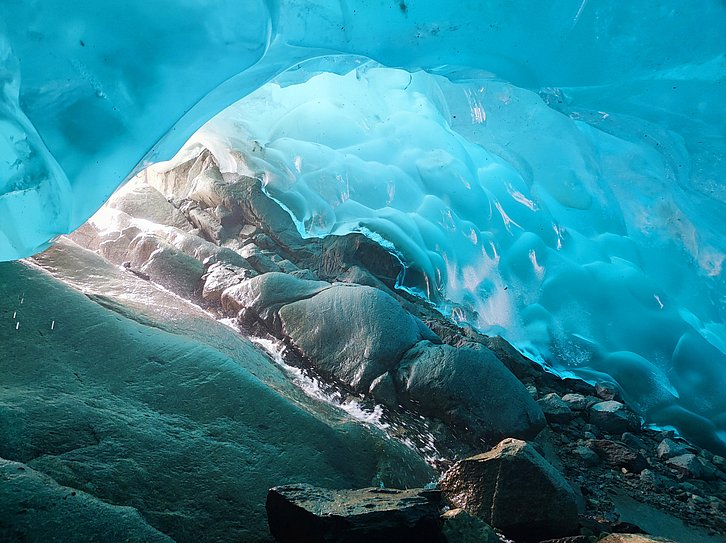
Meltwater beneath the Great Aletsch Glacier, Switzerland. Photo: M. Huss / GLAMOS. Source: WSL.
According to GLAMOS and the Swiss Academy of Sciences (SCNAT), the mean thickness of individual glaciers decreased by 2.5 to 4 metres, with local losses of up to 10 metres recorded on some glacier tongues.
Less snow and prolonged summer heat
The glaciers entered the melting season with below-average snow cover following a winter with little precipitation. Early heatwaves rapidly removed much of this protective layer, exposing the darker glacier ice underneath. Because bare ice reflects less sunlight than snow, it absorbs more solar energy, increasing melting during subsequent heatwaves.
By September, the monitoring assessment reported no remaining snow even at an elevation of 3,500 metres. The loss of this seasonal cover affects both summer melting and the formation of new ice: without snow surviving the summer and gradually compacting into ice, glaciers cannot replenish the mass they lose.
Alongside surface melting, researchers are observing changes within the glaciers themselves. Speaking to The Guardian, GLAMOS director Matthias Huss described how water flowing beneath the ice can carve out large cavities. The collapse of their roofs fragments the ice, contributing to the glaciers’ disintegration.
Shrinking water reserves and wider implications
The consequences extend beyond the mountain landscape because glacier meltwater helps sustain rivers during hot, dry periods, supporting irrigation, hydropower production and downstream navigation. Between July and September 2026, Swiss glaciers released approximately 2.2 trillion litres of water. While this temporarily helped ease summer water shortages, it also depleted ice reserves accumulated over decades and centuries.
As glaciers shrink, their capacity to provide this seasonal supply diminishes. In comments to the BBC, Huss emphasised that water released during one heatwave is no longer stored in the glacier for future dry periods. Continued ice loss therefore poses a growing challenge for communities and economic activities that depend on reliable summer river flows.
These changes illustrate how a warming climate affects both glaciers and the water systems they support. Although many small Alpine glaciers are already disappearing, researchers stress that reducing greenhouse gas emissions can still limit future glacier loss worldwide. Speaking to the BBC, Huss highlighted the importance of protecting ice in the Himalayas and polar regions. For the Arctic and other regions containing land-based ice, limiting further warming can also reduce the contribution of ice loss to global sea-level rise.
Source: GLAMOS, BBC, The Guardian
Photo: M. Huss, https://www.wsl.ch/en/news/die-schweizer-gletscher-verlieren-weitere-fuenf-prozent-ihres-volumens
The tags below provide an opportunity to view previously posted related news within the selected category