
News
NASA Scientists to Conduct Major Eclipse Research Mission in Iceland
Nearly 40 scientists from NASA are expected to arrive in Iceland in August 2026 to conduct an extensive research campaign during the total solar eclipse that will cross the country on August 12. The mission, which will include a research aircraft, atmospheric balloons and advanced scientific equipment, is believed to be the largest project NASA has undertaken in Iceland.
The eclipse will provide a rare opportunity for researchers to study both the Sun and Earth's atmosphere. NASA plans to operate a WB-57 high-altitude research aircraft from Keflavík Airport, enabling scientists to follow the path of the eclipse and capture detailed images of the Sun's corona, the outer layer of the solar atmosphere that becomes visible only during total solar eclipses.
In addition to aerial observations, atmospheric balloons will be launched to investigate how the sudden loss of sunlight affects Earth's atmosphere. Scientists hope the data gathered during the event will improve understanding of space weather, climate processes and atmospheric dynamics.
Researchers believe the findings could contribute to more accurate forecasts of auroral activity and help scientists better understand how solar activity influences satellite communications, aviation and electrical infrastructure. The research may also provide valuable information for future human missions to the Moon and Mars, where understanding space weather is considered increasingly important.
The project is being coordinated in Iceland through the Iceland Space Agency, which views the mission as a significant milestone for the country's growing role in international space research. The collaboration is expected to strengthen scientific ties between Icelandic institutions and one of the world's leading space agencies.
Why Do Solar Eclipses Occur?
Solar eclipses occur because of a remarkable cosmic coincidence. The Sun is approximately 400 times larger in diameter than the Moon, but it is also about 400 times farther away from Earth. As a result, the Sun and Moon appear almost exactly the same size in Earth's sky, covering about half a degree of arc.
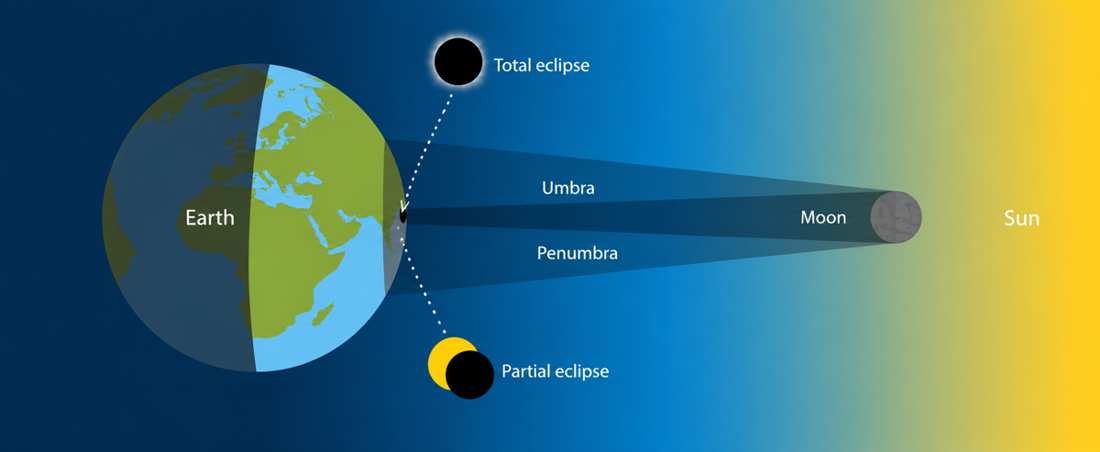
The Moon orbits Earth roughly once every month, passing between the Earth and the Sun during the new moon phase. However, because the Moon's orbit is slightly tilted relative to Earth's orbit around the Sun, the Moon's shadow usually passes above or below Earth.
Only when the alignment is nearly perfect and the Moon is at the right distance from Earth does it move directly in front of the Sun and completely obscure its disk. When this happens, the Moon casts a narrow, cone-shaped shadow onto Earth's surface. Anyone standing within this path of totality experiences a total solar eclipse, witnessing one of nature's most extraordinary spectacles.
The path of totality is typically only about 200 kilometres wide. Outside this narrow corridor, observers see only a partial eclipse, with part of the Sun still visible. While partial eclipses are impressive, they are dramatically different from a total eclipse. Even a Sun that is 99.9 percent covered remains bright enough to prevent the sudden darkness, visible corona and other unique phenomena that occur during totality. For eclipse chasers, being in exactly the right place at exactly the right time makes all the difference.
Historic Eclipse Draws Global Attention
The total solar eclipse on August 12, 2026, is expected to be one of the most significant astronomical events visible from Iceland in modern times. A total solar eclipse is among nature's most spectacular phenomena, occurring when the Moon passes directly between the Earth and the Sun, completely blocking sunlight for a brief period.
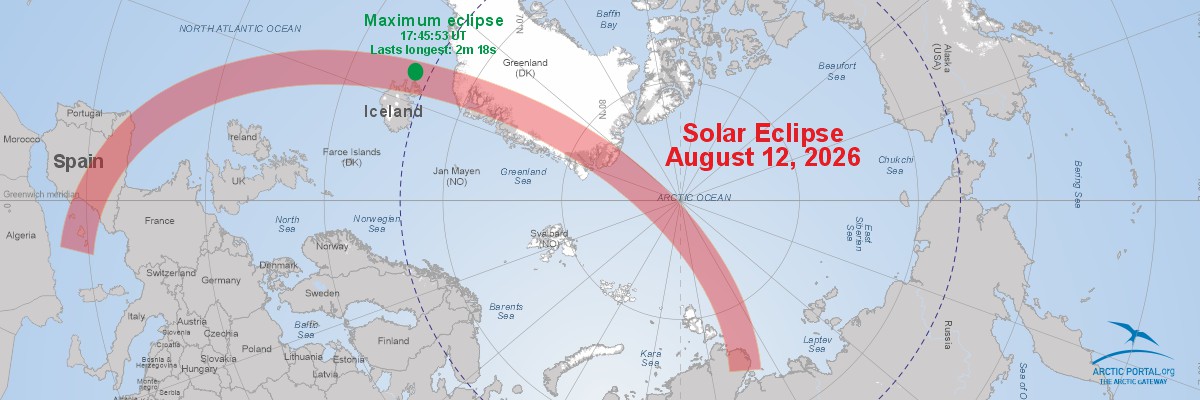
The eclipse path will cross the Arctic, Greenland, Iceland, Portugal and Spain, while a partial eclipse will be visible across much of northern North America, Scandinavia, Europe and western Africa.
For Reykjavík, the eclipse will begin as a partial eclipse at 16:47. Totality will begin at 17:48:19, reach maximum eclipse at 17:48:48 and end at 17:49:18. The partial eclipse will conclude at 18:47. While the entire eclipse event will last approximately two hours, totality in the capital will last for about one minute.
During totality, daylight will briefly fade into twilight, temperatures may drop, stars and planets may become visible, and the Sun's corona will emerge as a glowing halo surrounding the darkened solar disk. The experience is often described as one of the most dramatic natural events visible from Earth.
The longest duration of totality anywhere along the eclipse path will occur approximately 45 kilometres west of Látrabjarg in the Westfjords, where observers will experience 2 minutes and 18 seconds of darkness. The Moon's shadow will first touch Iceland at Straumsnesviti in Hornstrandir at 17:43:28, where totality will last for 1 minute and 26 seconds. At Látrabjarg, the eclipse will continue for 2 minutes and 13 seconds.
Travelling across the Earth's surface at roughly 3,400 kilometres per hour, the Moon's shadow will then sweep southward across Snæfellsnes, Reykjavík and the Reykjanes Peninsula. It will leave Iceland at Reykjanestá at 17:50:07, where totality will last 1 minute and 47 seconds.
In total, the Moon's umbral shadow will cross Iceland in just under seven minutes, from 17:43:28 until 17:50:07. After departing Iceland, the shadow will race south across the Atlantic Ocean before reaching Spain approximately 35 minutes later. In Mallorca, the eclipse will occur dramatically at sunset.
Because the path of totality passes through only a limited number of populated regions, astronomers, photographers and eclipse enthusiasts from around the world are expected to travel to Iceland. Tourism operators have already predicted exceptionally high demand for accommodation and transportation, particularly in western Iceland and the capital region.
Iceland's Opportunity in Space Science
The arrival of a major NASA research team highlights Iceland's increasing importance as a location for scientific observation and space-related research. Iceland's geographic position, clean air and access to unique natural phenomena such as auroras and volcanic landscapes have made it an attractive destination for international scientific projects.
The 2026 eclipse offers not only a rare scientific opportunity but also a chance for Iceland to showcase its capabilities in research, innovation and international collaboration. As scientists gather beneath the Moon's shadow next August, Iceland will become a focal point for both astronomical discovery and public interest in space science.
For a brief period on August 12, 2026, the eyes of the scientific world will be firmly fixed on Iceland as one of nature's rarest and most spectacular phenomena unfolds across the North Atlantic sky.
Source: RUV.is, Solmyrkvi2026
The tags below provide an opportunity to view previously posted related news within the selected category