
News
Under the Ice: Why Arctic Science Needs More Divers
A new generation of scientific divers is being trained to operate beneath Arctic ice, highlighting the growing need for specialised expertise to support research in rapidly changing polar environments.
 Recent training initiatives in northern Finland demonstrate the importance of expanding the number of professionals capable of conducting under-ice research. These programmes aim to equip scientists with the skills required to safely dive beneath ice layers and directly observe marine ecosystems that remain largely inaccessible through conventional methods.
Training in controlled Arctic environments
Training is currently taking place in Kilpisjärvi, northern Finland, where divers practise under-ice techniques in frozen lakes. These courses are provided by the Finnish Scientific Academy at the University of Helsinki’s Kilpisjärvi Biological Station.
Such controlled environments offer safer conditions while still simulating the challenges of Arctic diving, including extreme cold, limited visibility, and restricted access points. While the training takes place inland, the skills are intended for use across Arctic marine environments, including coastal waters, fjords, and sea ice ecosystems throughout the region.
Participants—often with backgrounds in fields such as marine biology and filmmaking—develop the skills needed to manage risks such as freezing equipment and low visibility.
Exploring the hidden world beneath the ice
Beneath the ice, unique ecosystems exist in low-light conditions, where algae, small organisms, and seafloor species form the foundation of Arctic marine life. These environments play a key role in the broader Arctic system but remain difficult to study using remote technologies alone.
As the Arctic continues to warm at a rate significantly faster than the global average, understanding conditions beneath the ice has become increasingly urgent. Researchers are working to assess how climate change is affecting ecosystems on and below the seafloor, including species that depend on stable ice conditions.
Why human divers are still essential
Human divers remain essential for Arctic research, particularly in environments that are difficult to access using remote or robotic systems. Under-ice conditions limit visibility and access, making direct observation and manual sampling critical for understanding ecosystem dynamics and environmental change.
While autonomous tools provide valuable data at larger scales, divers enable detailed, site-specific investigations that are not easily replicated by other methods.
- Ecosystem Monitoring: Researchers study Arctic flora and fauna, including algae and seafloor organisms such as starfish, sea spiders, and sponges.
- Climate Change Data: Divers collect direct measurements of ice thickness, density, water temperature, and salinity to better understand how rapidly polar regions are changing.
- New Discoveries: Expeditions have revealed thriving ecosystems beneath icebergs and previously unknown species of fish and crustaceans.
Challenges and safety considerations
The number of individuals qualified to conduct scientific diving in polar regions remains limited. Under-ice diving requires specialised training, equipment, and strict safety procedures due to harsh and unpredictable conditions.
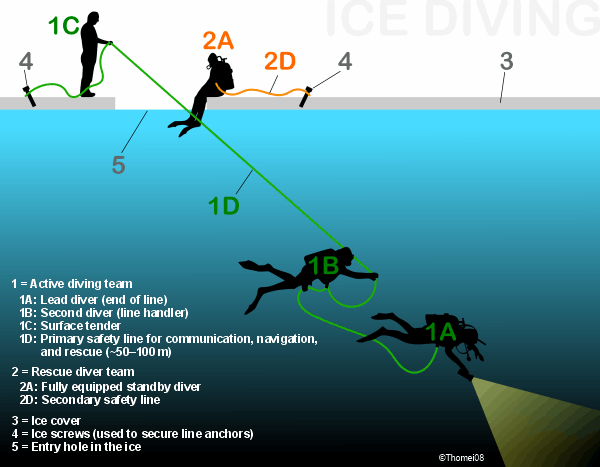
Diving beneath a solid “ceiling” of ice is considered an overhead environment, meaning divers cannot surface directly and must return to a fixed entry point. This significantly increases the complexity and risk of operations.
To mitigate these risks, rigorous safety protocols are essential:
- Specialised equipment, including dry suits and backup air systems to prevent failure in freezing conditions
- Tethered lines to maintain communication and orientation with the surface team
- Emergency preparedness, with trained safety divers ready to assist if needed
- Environmental awareness, including potential encounters with wildlife or shifting ice conditions
Supporting future Arctic research
Training programmes are playing a key role in building capacity for future Arctic research. These initiatives focus not only on diving techniques but also on logistics, risk management, and scientific methods tailored to polar conditions.
As environmental changes accelerate, the demand for in situ observations is expected to grow. Expanding the pool of trained scientific divers is increasingly seen as a critical step in improving understanding of Arctic ecosystems and supporting informed responses to ongoing climate-driven transformations.
As Arctic conditions continue to evolve, improving access to under-ice environments will be essential for monitoring ecosystems and understanding long-term environmental change.
The tags below provide an opportunity to view previously posted related news within the selected category